

Car shipping trailers are built around strict physical limits that shape every design on the road. Width is capped at 8.5 feet, height usually falls between 13.5 and 14 feet, and total weight cannot exceed 80,000 pounds. That weight must also be distributed correctly across the axles, typically 20,000 pounds per axle and 34,000 pounds per tandem axle.
These constraints are not minor details. They directly influence how many vehicles a trailer can carry, how they are arranged, and which routes a carrier can legally take.
Once you understand these limits, the differences between auto transport trailers become more practical. Each type exists to balance capacity, protection, and maneuverability within those boundaries.

Flatbed Trailers
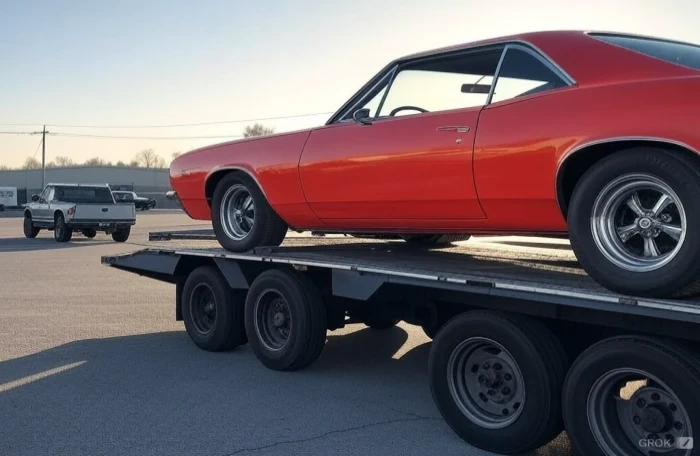
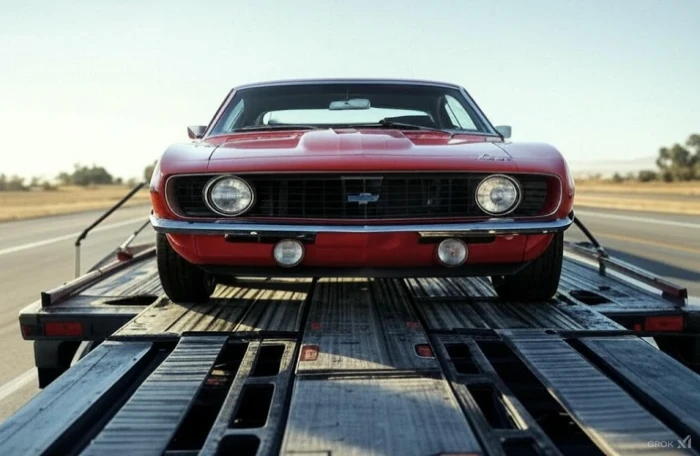
Flatbed trailers represent the most basic form of car shipping. They consist of a single open platform with no sides or roof, which makes loading straightforward and flexible.
This design is especially useful for vehicles that cannot run or have unusual dimensions. Without upper decks or tight ramp angles, drivers can load vehicles more easily using winches or gradual inclines. Flatbeds typically carry one vehicle, though larger versions may handle more in certain cases.
The tradeoff is complete exposure. Vehicles transported this way are fully subject to weather and road debris. For most standard shipments, this level of exposure is unnecessary, so flatbeds are usually reserved for situations where other trailer types are not suitable.
Hotshot Car Hauling Trailers
Hotshot car hauling focuses on smaller loads and greater flexibility. A heavy-duty pickup truck pulls a compact trailer, often using a gooseneck hitch for added stability.
These trailers usually carry one vehicle, though some configurations can handle up to four. Their smaller size allows them to reach locations that larger carriers cannot access, including tight residential streets and areas with limited turning space. This makes them a practical option when pickup or delivery locations are difficult to reach.
Fuel efficiency is another factor. Hotshot setups can achieve between 10 and 12 miles per gallon, which is significantly better than larger multi-car rigs. However, since fewer vehicles share the trip, the cost per vehicle is higher. This setup prioritizes access and speed rather than volume.
Wedge Trailers
Wedge trailers expand on the hotshot model by increasing capacity while maintaining a relatively compact footprint. Their sloped design allows them to carry three to four vehicles without requiring a full-size semi-truck.
This balance makes wedge trailers well-suited for regional transport. They offer greater efficiency than single-vehicle setups while still navigating areas that larger carriers may avoid. Dealership transfers and shorter-distance moves often rely on this type of trailer.
Compared to larger multi-car haulers, wedge trailers sacrifice capacity. However, they offer greater routing flexibility, making them more practical in certain situations.
Multi-Car Hauler Trailers
Multi-car haulers are the most common type of trailer used in open car transport. These large, two-level trailers are designed to move several vehicles at once, typically between seven and eleven, using adjustable ramps and stacked platforms.
This high capacity is what keeps open transport pricing lower, often ranging from $400 to $800 per vehicle. By spreading costs across multiple shipments, carriers can offer more competitive rates while still covering fuel and operating expenses.
Load placement on these trailers is carefully managed. Vehicles are arranged to stay within legal height limits and to distribute weight evenly across axles.
Fuel efficiency decreases as capacity increases, with fully loaded nine-car rigs averaging about 5.0 to 6 miles per gallon. Despite this, the ability to move more vehicles per trip keeps overall operations efficient.

Stinger-Steer Trailers
Stinger-steer trailers are a specialized version of the multi-car hauler designed to maximize capacity. The fifth-wheel hitch is positioned lower and farther back on the truck, allowing the trailer to extend over the cab.
This configuration increases capacity to nine to eleven vehicles while maintaining stability through a lower center of gravity. Federal regulations allow these trailers to be at least 80 feet long, with additional overhang allowances of approximately 4 feet at the front and 6 feet at the rear.
These trailers are built for long-distance, high-volume transport. Their design is highly specialized, limiting their use outside of car hauling.
High-Mount Carriers
High-mount carriers use a more conventional connection point, similar to standard semi-trailer setups. The trailer attaches higher on the truck, which reduces overall capacity to about seven or eight vehicles.
While this limits how many cars can be transported in a single trip, it increases flexibility. The same tractor can be used for other types of freight, allowing carriers to adapt their operations more easily. This flexibility can be useful in regional markets where demand varies.
The difference between stinger-steer and high-mount setups comes down to efficiency versus adaptability. One is designed to carry more vehicles per trip, while the other allows for broader use across different types of loads.
Enclosed Car Shipping Trailers
Enclosed car shipping trailers prioritize protection rather than capacity. Instead of leaving vehicles exposed, they transport them in a covered structure that shields them from weather, debris, and visibility issues.
Hard-sided enclosed trailers use solid panels to create a sealed environment. They provide the highest level of protection and are often used for high-value or delicate vehicles. Soft-sided trailers use curtain systems that allow easier access during loading but offer slightly less protection against impact and fine particles.
Capacity in enclosed trailers typically ranges from one to six vehicles. This lower capacity increases the cost per shipment. Enclosed transport pricing generally ranges from $700 to $2,000, reflecting a 30 to 40 percent increase over open transport.
Capacity, Cost, And Operating Constraints
Every trailer type operates within the same regulatory framework. Gross Vehicle Weight Rating and federal height restrictions limit how much can be carried and how it must be arranged. These limits explain why capacity ranges from one to four vehicles on smaller trailers to as many as 11 on specialized multi-car haulers.
Operating costs also play a major role. Fuel alone can account for 30 to 40 percent of a carrier’s revenue, especially for large rigs with lower fuel efficiency. Insurance requirements add another layer of cost. Carriers must maintain liability coverage of at least $750,000, though $1,000,000 is common, and cargo coverage typically ranges from $100,000 to $250,000 per load.
These factors are built into pricing, even if they are not immediately visible. Larger trailers reduce cost per vehicle through volume, while enclosed trailers increase cost by reducing risk and capacity.

How AmeriFreight Auto Transport Matches Trailer Types
AmeriFreight Auto Transport works with carriers that operate across all major trailer types, from single-vehicle hotshot trailers to large multi-car haulers and enclosed units.
Customer service agents focus on the factors that affect the outcome. Vehicle value, route conditions, and timing flexibility all influence which trailer type is most appropriate. The goal is to match the equipment to the situation rather than defaulting to a single option.
There is no upfront payment until you choose a carrier. That allows time to weigh cost, protection, and accessibility before making a decision.